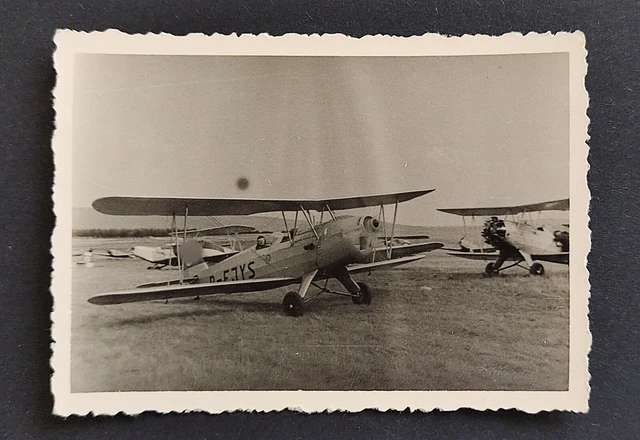
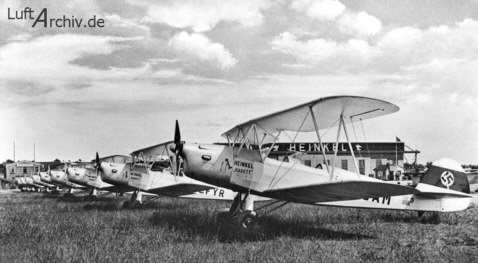
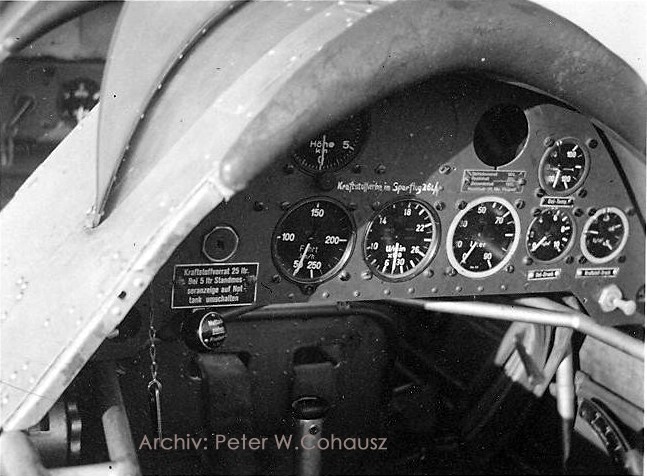
The Heinkel He 72 Kadett (Cadet) was a German single-engine biplane trainer of the 1930s. It was known to its pilots as the Zitterrochen (Quivering Ray) as it shook madly.
Development
The Kadett was designed in 1933 to meet an official requirement for a basic trainer. It was a single-bay biplane of fabric-covered, metal construction with open cockpits, a staggered wing, a strut-braced tail unit, and fixed tailskid undercarriage. The prototype was powered by a 104 kW (139 hp) Argus As 8B air-cooled inline engine.
The first production model, the He 72A retained the As 8B engine in early batches, but later production aircraft had a 112 kW (150 hp) As 8R. The He 72A was superseded by the He 72B, which was the major production version. This was powered by a 120 kW (160 bhp) Siemens-Halske Sh 14A radial.
The He 72B was produced as the He 72B-1 landplane and He 72BW Seekadett ("Sea Cadet") twin-float seaplane. The civil development was the He 72B-3 Edelkadett ("Noble Cadet").
Operational history
The Kadett entered service with National Socialist Flyers Corps before the formation of the Luftwaffe. Later, it became a standard basic trainer with the Luftwaffe. Slovak forces used it in the attack role.
Variants
- He 72A Kadett : Initial production version.
- He 72B :
- He 72B-1 :
- He 72B-3 Edelkadett : Civil adaptation of He 72B-1. 30 built.
- He 72BW Seekadett : Twin-float seaplane. Prototype only.
- He 172 - He 72B with NACA cowling. Prototype only in 1934.
Operators
- Bulgaria
- Bulgarian Air Force
- Czechoslovakia
- Czechoslovakian Air Force (Postwar)
- Germany
- National Socialist Flyers Corps
- Luftwaffe
- Japan
- Imperial Japanese Navy - one aircraft
- Slovakia
- Slovenské vzdušné zbrane
- Slovak Insurgent Air Force
Specifications (He 72B)
Data from Die Deutsche Luftrüstung 1933–1945 Vol.2 – Flugzeugtypen Erla-Heinkel
General characteristics
- Crew: 2
- Length: 7.5 m (24 ft 7 in)
- Wingspan: 9 m (29 ft 6 in)
- Height: 2.7 m (8 ft 10 in)
- Wing area: 20.7 m2 (223 sq ft)
- Empty weight: 540 kg (1,190 lb)
- Max takeoff weight: 865 kg (1,907 lb)
- Fuel capacity: 110 L (29 US gal; 24 imp gal)
- Powerplant: 1 × BMW-Bramo Siemens-Halske Sh 14A 7-cylinder air-cooled radial piston engine 160 PS (160 hp; 120 kW)
- Propellers: 2-bladed fixed-pitch propeller, 2.2 m (7 ft 3 in) diameter
Performance
- Maximum speed: 194 km/h (121 mph, 105 kn) at 1,000 m (3,300 ft)
- Cruise speed: 158 km/h (98 mph, 85 kn)
- Landing speed: 80 km/h (50 mph; 43 kn)
- Range: 820 km (510 mi, 440 nmi)
- Service ceiling: 4,200 m (13,800 ft)
- Rate of climb: 3 m/s (590 ft/min)
- Time to altitude: 2,000 m (6,600 ft) in 14 minutes
See also
Aircraft of comparable role, configuration, and era
- Bücker Bü 131 Jungmann
- de Havilland DH82 Tiger Moth
- Tachikawa Ki-17
References
Bibliography
- Sinnhuber, Karl (2012). Salzburg To Stalingrad. UK: Milton Keynes. ISBN 9781471702228.
Further reading
- Wood, Tony; Gunston, Bill (1 November 1984). Hitler's Luftwaffe : a pictorial history and technical encyclopedia of Hitler's air power in World War II (2nd ed.). Chartwell Books. ISBN 978-0890097588.